
Yahoo Finance.
The calendar ticks over into September this week, signaling — at least in this house — the end of summer, despite what any calendar "officially" says about the equinox.
We have hardly seen any summer doldrums this go-round. Plenty of action from the White House, the AI trade, the Fed, and the bond market saw to that, as the classic summer autopilot, which some investors perhaps would have liked to see, was nowhere to be found this year.
Stocks go into the week tracking about 1% off record highs after being buoyed by Nvidia's infusion of confidence in the AI trade and an increase in oil flows through the Strait of Hormuz, now at around two-thirds of their prewar level, according to Goldman Sachs.
With earnings season mostly wrapped up, the Fed, the bond market, and some of the nonspending aspects of the AI transformation — SaaSpocalypse or lack thereof — are more top of mind.
Still, the calendar has plenty to circle: quarterly results from Palo Alto Networks (PANW) and Dell Technologies (DELL) on Tuesday; Broadcom (AVGO), Snowflake (SNOW), and Hewlett Packard Enterprise Company (HPE) on Wednesday; and DocuSign (DOCU) and Victoria's Secret (VSXY) on Thursday. Something for everyone.
On the economic front, Friday's jobs report leads the charge, joined by job openings data and economic activity readings on Tuesday, private payrolls data on Wednesday, and job cuts data on Thursday.
Warsh recalibrates the bond markets — and a September hike
Fed Chairman Kevin Warsh's speech may not have had "forward guidance." The chair vigorously defended the central bank's new strategy of keeping its cards closer to its vest.
But Warsh gave some much-needed clarity to markets: Though Warsh is looking at wider inflation metrics, PCE was featured prominently; Warsh agrees with other governors that inflation is too high and, most critically, that current monetary policy isn't particularly restrictive.
With those things on the table, it's no wonder that the bond market downshifted and recalibrated its outlook, now pricing in a much higher probability of a rate hike at the September meeting. On Friday afternoon, following the speech, the CME's FedWatch tool showed a 60% chance of a hike, up from just 35% the day before.
Federal Reserve Chairman Kevin Warsh (right) talks with Tiff Macklem, governor of the Bank of Canada, at the Jackson Hole Economic Symposium on Aug. 28, 2026, in Jackson Hole, Wyoming. (Natalie Behring/Getty Images) ·Natalie Behring via Getty Images
That may be more than the day before, but this is still a coin flip.
"Today's speech rightly erred on the hawkish side of the ledger," BlackRock's Rick Rieder noted. "We don't by any means think that it necessitates a rate hike in September, especially with more employment and inflation reports before that meeting."
Despite the change in expectations, investors will be firmly watching longer-term bond yields, which didn't see much relief following the chair's comments — perhaps in part because they failed to address the historic debt and deficits.
With yields still eye-wateringly high, the bond problem does not appear to be going away anytime soon.
The jobs report still matters as September's Fed meeting approaches
Warsh and the markets have been firmly focused on the price-stability side of the mandate as inflation continues to stubbornly bite.
But with the end of the month here, it's time for another jobs report. Economic expectations point to nothing crazy from the labor side of the Fed's mandate. Job creation appears to have continued amid the strong economy.
Still, with the Fed decision up in the air in two weeks, it may not take much macroeconomic news to move the needle: A hotter-than-expected print could give extra color to FOMC members who want to see a hike but are worried about the potential cost.
Signage for a job fair is seen on Fifth Avenue in New York City. (Reuters/Andrew Kelly) ·Reuters / REUTERS
"We expect a modest recovery of perhaps 65k in August, but the low-hire, low-fire narrative persists," ING economist James Knightley wrote in a note to clients. "Tariff-related caution and higher borrowing costs are likely to keep that in place for the rest of the year."
The jobs report has also increasingly become an odd barometer of the economy's health, on the one hand showing strength, but on the other a sinister underbelly as the labor participation rate tanks. Something that Knightley said "likely reflects some disillusionment given the lack of hiring in the economy."
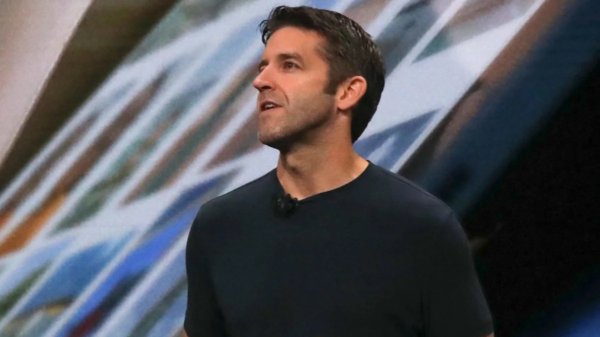
Tim Cook hands the big Apple to John Ternus
This newsletter isn't in the prediction business. But once in a while, when we are forced to throw out some forecasts, we will. And sometimes we are even right.
One of those times was about the future of Apple, when we made predictions for the year at the start of 2025. We wrote that Apple Intelligence wouldn't take off, and that it wouldn't matter, because Apple is Apple and didn't need to trip over itself to get in on the AI frenzy. (Pretty good guess.)
We went further and declared: Tim Cook never launches another product at the company for the rest of his tenure. With Cook handing the CEO baton to John Ternus this week, this spicier take turned out to be true. By almost any metric, Cook's track record is exceptional. He has overseen the growth of the company's market cap from $350 billion to between $4 trillion and $5 trillion. He solidified the iPhone as society's touchstone device, a portal to the internet and a companion to daily life, as essential to many people as an external organ.
But our old prediction of Cook stemmed from a long-standing critique: He isn't a creative genius in the mold of Steve Jobs, but rather a savvy operator. There's a way to view that as a wonderful attribute, and shareholders would probably agree.
Apple senior vice president of hardware engineering John Ternus and CEO Tim Cook attend the season four premiere of the Apple TV series "Ted Lasso" on July 27, 2026, in Los Angeles. (Stewart Cook/Apple TV via Getty Images) ·Stewart Cook via Getty Images
Cook shepherded his company into legacy-tech status, gaining momentum through the mobile and social eras and preserving the company's individuality at the dawn of the AI age — while many others played copycat or, worse, debased themselves by chasing shiny LLM objects. Cook's legacy of turning Apple into a services behemoth is also a commentary on our phone-addled times. You won't find the words "addiction" and "extraction" in Big Tech's glowing earnings reports.
Yet every popular criticism of technology — in art, education, public policy, and economics — centers around people spending too much time and attention on their phones and on the platforms the tech giants control.
Cook isn't to blame for all of that — that usually falls on Zuckerberg and his peers. But if you squint, there's a way of seeing Apple as a kind of innovative landlord, and we're all, figuratively and literally, paying rent.
Economic data: S&P Global US manufacturing PMI, August final reading (53.3 expected, 53.2 previously); ISM manufacturing, August (55.2 expected, 55.6 previously); ISM prices paid, August (71.2 expected, 71.1 previously); ISM new orders, August (57 expected, 56.7 previously); ISM employment, August (52.5 expected, 52.8 previously); Construction spending, month-on-month, July (0% expected, -0.1% previously); JOLTS job openings, July (7.3 million expected, 7.359 million previously); JOLTS quits rate, July (+2% previously); JOLTS layoffs rate, July (+1.1% previously); Dallas Fed services activity, August (6.6 previously); Omdia total vehicle sales, August (16.3 million expected, 16.33 million previously)
Economic data: MBA mortgage applications, week ended Aug. 28 (-1% previously); ADP employment change, August (+46,000 expected, +44,000 previously); Factory orders, July (+0.6% expected, -0.3% previously); Durable goods orders, July final reading (+1.1% expected, +1.1% previously)
Earnings calendar: Broadcom (AVGO), Snowflake (SNOW), Hewlett Packard Enterprise Company (HPE), NetApp (NTAP), Five Below (FIVE), Brown-Forman Corporation (BF-A, BF-B), FuelCell Energy (FCEL)
Thursday
Economic data: Challenger job cuts, year-on-year, August (-46.1% previously); Imports, month-on-month, July (+1.4% expected, -1.8% previously); Exports, month-on-month, July (-0.8% expected, -0.9% previously); Nonfarm productivity, second-quarter final reading (+1.4% expected, +1.4% previously); Initial jobless claims, week ended Aug. 29 (205,000 expected, 203,000 previously); Continuing claims, week ended Aug. 22 (1.79 million expected, 1.778 million previously); S&P Global US services PMI, August final reading (56.8 expected, 56.8 previously); S&P Global US composite PMI, August final reading (56 previously); ISM services index, August (54.1 expected, 54.1 previously); ISM services, prices paid, August (69.5 expected, 70.3 previously); ISM services, new orders, August (57 expected, 57.2 previously); ISM services, employment, August (49 expected, 47.4 previously)
Economic data: Change in nonfarm payrolls, August (+58,000 expected, -23,000 previously); Change in private payrolls, August (+50,000 expected, +30,000 previously); Change in manufacturing payrolls, August (+5,000 expected, +5,000 previously); Unemployment rate, August (4.1% expected, 4.1% previously); Labor force participation rate, August (61.4% expected, 61.4% previously); Average hourly earnings, month-on-month, August (+0.3% expected, +0.1% previously); Average hourly earnings, year-on-year, August (+3% expected, +3.2% previously)


0 Yorumlar
Yorum ekle